Ejection
OPERATION
OF THE FLATJET
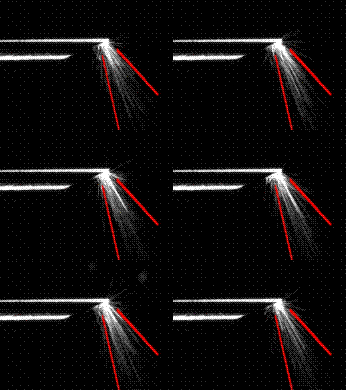
Fig.
8
Spray at the FlatJet nozzle
|
The
plate resonator is attached to the liquid conducting
tube in the junction marked “e”. In the
junction the vibration created in the resonator
is transmitted to the liquid conducting tube where
the laminar mode becomes bending mode and the vibration
goes on towards the ends of the liquid conducting
tube.
If
the design of the system comprising the resonator
and the liquid conducting tube is appropriate all
of the resonator’s vibration energy can be
transmitted to the liquid conducting tube. Since
the vibrating mass correlated with the length in
the movement direction of the wave is considerably
smaller than in the resonator the vibration amplitude
increases significantly.
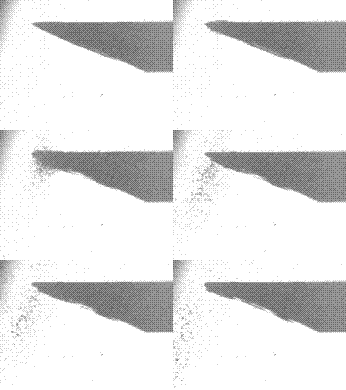
Fig.9
Overtone Resonance
|
The
vibration amplitude can be increased further if
the vibrating mass correlated with the length is
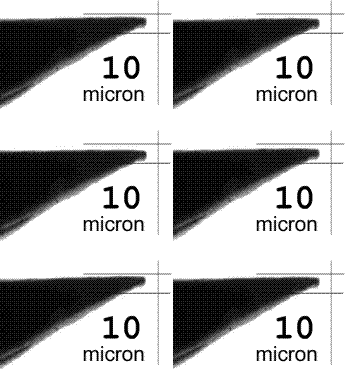
reduced gradually. In the case of the FlatJet system
this was achieved by cutting the end of the liquid
conducting tube at an angle.


.gif)